POWER-E-COM turns experience from 6 European countries into practical pathways for future energy communities
After three years of cooperation, the EU LIFE project POWER-E-COM is providing practical answers on the question “What does it take to turn the idea of an energy community into a viable local solution?”
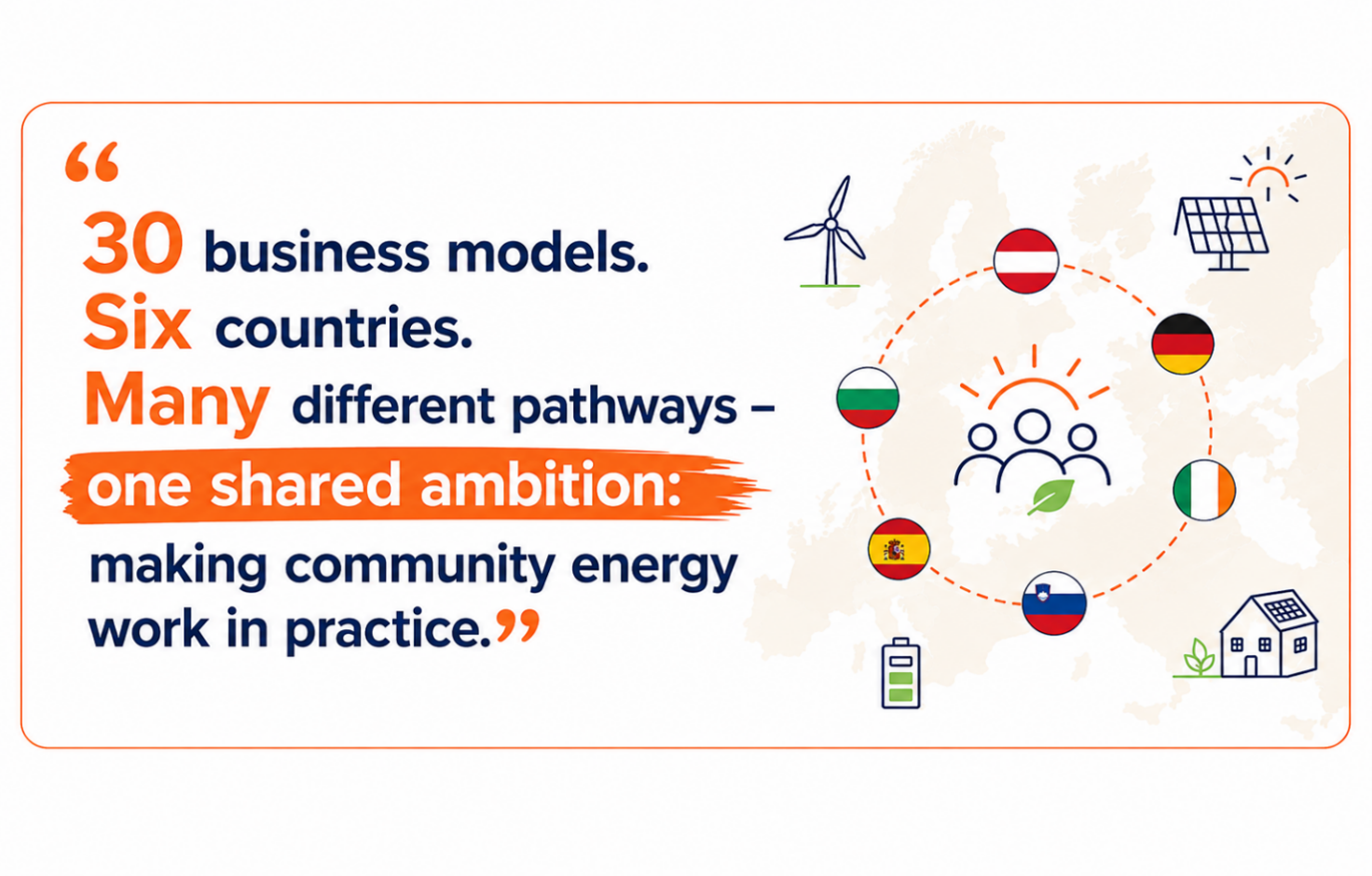
Partners from Austria, Bulgaria, Germany, Ireland, Slovenia and Spain have developed 30 energy community business models – 5 in each country – showing how citizen and renewable energy communities can be organised, financed and implemented under very different local conditions.
The models translate the concept of energy communities into concrete, locally adapted pathways for action, covering different legal forms, ownership structures, technologies, investment approaches and ways of sharing benefits.
30 Models – Different Approaches, One Common Goal
Using an adapted CANVAS approach, partners examined key elements needed to make an energy community viable: location, legal form, investors and members, planned energy projects, expected installed capacity, investment and revenues, social and environmental benefits and implementation timelines.
This common framework made it possible to compare very different local realities while keeping the focus on viability and replication.
The results show that energy communities can support a wide range of local needs. Most models focus on sharing renewable electricity from solar PV, wind or small hydropower, while several also address renewable heat, district heating, batteries, flexibility and electric mobility.
The findings also confirm that there is no one-size-fits-all solution for energy communities.
Citizens form the largest share of members, but energy communities bring together much more than individual households. The models also involve municipalities, SMEs, public buildings, hotels, banks, cooperatives, hospitals, fire brigades and other local organisations.
From Business Models to Real Communities
One of the most important achievements is that the 30 models were not developed as desk studies alone.
Throughout the project, they were shared and discussed with local stakeholders through meetings, workshops and events. Citizens, municipalities and other local actors had the opportunity to explore the proposed approaches, discuss their feasibility and contribute their own perspectives. This process helped connect technical and financial planning with local needs and realities.
As a result, the final business models provide a practical bridge between planning and real-life implementation and can help municipalities, citizens and organisations interested in developing new energy communities take the next step.
“The business models developed during the project have been designed to serve
as the foundation for the creation and replication of new viable energy communities
across Europe, based on common principles while allowing for flexibility
so that they can be easily and simply adapted to each specific need.”
Francisco Puente, ESCAN, POWER-E-COM WP4 Lead
A Resource for the Future of Community Energy
The diversity of the 30 models is itself one of POWER-E-COM’s most important findings. Different national regulations, energy markets, local resources and community structures require different solutions.
At the same time, the experience from all six countries shows that successful energy communities depend on more than technology. Local engagement, appropriate governance, viable financing and solutions adapted to local conditions are essential for turning community energy ambitions into action.
The knowledge generated through the 30 business models will remain an important part of POWER-E-COM’s legacy, supporting the further development and replication of Renewable and Citizen Energy Communities across Europe.
Discover the POWER-E-COM results
For more information about the business models, practical tools and results developed within POWER-E-COM, visit the project website: power-e-com.eu.
Follow POWER-E-COM on LinkedIn and YouTube for project stories, videos and experiences from across Europe.
About POWER-E-COM
POWER-E-COM – Empowering Renewable and Citizen Energy Communities is a European LIFE project supporting the development of Renewable and Citizen Energy Communities across Europe. Partners from Austria, Bulgaria, Germany, Ireland, Slovenia and Spain work together to provide practical support, develop viable business models, strengthen knowledge and capacities, and improve conditions for citizen participation in the energy transition.
The project runs from October 2023 to September 2026 and is co-funded by the European Union through the LIFE Programme.
Communication media contact:
The POWER‑E‑COM Communications Team
Email: power-e-com@energiewende-oberland.de
EU funding acknowledgement:
Co-funded by the European Union. Views and opinions expressed are however those of the author(s) only and do not necessarily reflect those of the European Union or CINEA. Neither the European Union nor the granting authority can be held responsible for them.